
Understanding what exosomes are, what the evidence currently shows, and how topical scalp wellness systems differ from injectable exosome procedures can help you make a more informed decision about your hair and scalp health.
What Are Exosomes?
Exosomes are extremely small particles released by cells. They carry proteins, lipids, growth factors, and genetic material from one cell to another, helping cells communicate and respond to their surrounding environment.
One way to understand exosomes is to think of them as microscopic messages. Cells use these messages to coordinate processes such as repair, maintenance, inflammation, and normal cellular activity.
Exosomes are not stem cells. Some exosome products are derived from cultured stem cells, but the finished material contains signaling particles rather than the original living cells. Other products use plant-derived extracellular vesicles or bioactive ingredients designed to provide signaling support through a different biological pathway.
Why Are Researchers Studying Exosomes for Hair Loss?
Hair follicles continuously move through periods of growth, transition, rest, and shedding. Genetics, hormones, age, illness, medication, nutrition, stress, and inflammation can disrupt this cycle or gradually cause follicles to produce finer, shorter hair.
Researchers are investigating whether certain exosome preparations can influence cellular pathways involved in:
- Hair follicle growth and activity
- Communication between follicular cells
- Inflammatory responses around the follicle
- Blood vessel formation and tissue support
- The transition from the resting phase into the active growth phase
These possible mechanisms help explain the scientific interest in exosomes. However, showing that a biological process is possible does not prove that every exosome product will produce visible hair growth.
The source, concentration, purity, processing, storage, delivery method, and formulation of a product can all affect its activity. The cause and stage of the individual’s hair loss are equally important.
What Does Current Research Say About Exosomes for Hair Loss?
Early clinical studies have reported improvements in hair density, thickness, or growth among some patients receiving exosome-based treatments. However, the available evidence is still limited.
A 2025 systematic review of exosomes and hair regeneration found encouraging results across several forms of hair loss. The researchers also identified major limitations, including small patient groups, differences among exosome sources, inconsistent treatment protocols, and relatively short follow-up periods.
Another clinical review identified only nine relevant studies involving 125 patients who received exosome treatment for hair loss. This is not enough evidence to determine which products, concentrations, or delivery methods are most effective over the long term.
The responsible conclusion is that exosome science is promising, but not yet definitive. Exosomes should not be presented as a guaranteed cure, a permanent solution, or a treatment capable of restoring every inactive follicle.
Are Exosome Hair Treatments FDA Approved?
The U.S. Food and Drug Administration has not approved an exosome product for treating hair loss. The FDA also continues to warn consumers about unapproved human cell and tissue products marketed with unsupported regenerative claims.
The agency’s current consumer warning about unapproved regenerative medicine products emphasizes that products requiring FDA approval should be evaluated through appropriate clinical research before being marketed for treating medical conditions.
This distinction is particularly important because the term “exosome therapy” may be used to describe very different products. An injected human-cell-derived preparation is not the same as a topical plant-based scalp wellness formula. Consumers should ask what a product contains, how it is used, what evidence supports it, and whether the claims being made are appropriate for that specific formulation.
Why Healthy Hair Starts With a Healthy Scalp
Exosome research has helped bring greater attention to the biological environment surrounding the hair follicle. A follicle does not operate in isolation. It is affected by the condition of the skin, oil production, inflammation, buildup, hydration, circulation, and other factors within the scalp.
Common scalp concerns can include:
- Excess sebum and oily buildup
- Dryness, flaking, or irritation
- Dandruff and scaling
- Inflammatory scalp conditions
- Product residue surrounding follicle openings
- Hair shaft weakness and breakage
Not every scalp condition causes permanent hair loss, and improving scalp health cannot reverse every form of follicle damage. However, identifying and managing visible scalp concerns can be an important part of supporting healthier-looking hair.
The American Academy of Dermatology Hair Loss Resource Center also emphasizes that hair loss has many possible causes. Obtaining the right diagnosis is essential because treatments that help one type of hair loss may not be appropriate for another.
How DE|RIVE Fits Into the Exosome Conversation
The DE|RIVE Hair Wellness System at HRC Dayton is a topical, non-invasive approach designed to improve scalp health and support thicker, fuller-looking hair. It uses plant-based bioactive technology as part of a professional in-clinic protocol and at-home scalp care program.
DE|RIVE should not be confused with injected human stem-cell-derived exosome products. It represents a different category of care centered on topical plant-based ingredients, scalp wellness, and consistent non-invasive support.
This distinction matters. Broad discussions about exosomes can easily combine injectable biologic procedures, plant-derived extracellular vesicles, topical serums, and products using exosome-inspired signaling technology. These are not interchangeable, and evidence about one formulation should not automatically be applied to another.
For people who want a needle-free approach focused on the scalp environment, DE|RIVE offers a practical option that can be considered after a professional evaluation.
Where CRLAB Trichological Treatments Fit
Some people experiencing thinning hair also have oil imbalance, dandruff, inflammation, dryness, buildup, or other visible scalp concerns. In these situations, treatment should begin with understanding the condition of the scalp rather than automatically selecting a hair growth product.
HRC Dayton offers individualized CRLAB trichological scalp treatments designed to address specific scalp conditions. Professional protocols may focus on cleansing, sebum regulation, hydration, dandruff, scalp sensitivity, or support for weakened and thinning hair.
CRLAB treatments and DE|RIVE serve different purposes. Depending on the evaluation, one may be more appropriate than the other, or scalp care may form one part of a broader hair restoration plan.
Why Professional Hair and Scalp Analysis Matters
Visible thinning does not reveal its cause. A wider part, receding hairline, excessive shedding, scalp visibility, and reduced density can result from many different conditions.
Possible contributing factors include:
- Male or female pattern hair loss
- Stress-related shedding
- Hormonal or thyroid changes
- Nutritional deficiencies
- Medication or illness
- Hair breakage
- Inflammatory scalp conditions
- Scarring forms of alopecia
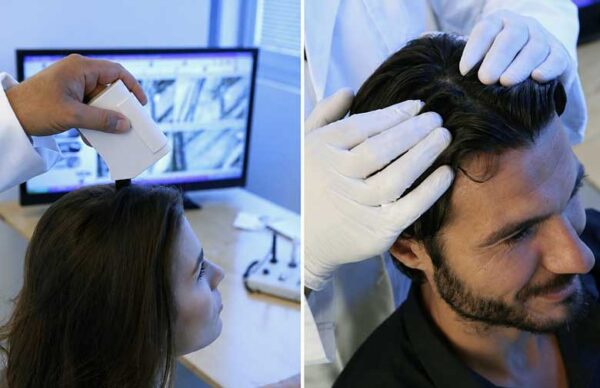
A professional hair and scalp analysis at HRC Dayton can examine the scalp under magnification, identify visible patterns of thinning, and evaluate concerns such as buildup, irritation, miniaturization, or hair shaft damage.
HRC Dayton does not diagnose or treat underlying medical disease. When symptoms suggest a condition requiring medical attention, clients may be advised to consult a dermatologist or other qualified healthcare professional.
Frequently Asked Questions About Exosomes and Hair Loss
Are exosomes the same as stem cells?
No. Exosomes are signaling particles released by cells. They do not contain the original living stem cells, although some laboratory exosomes may be collected from stem-cell cultures.
Can exosomes regrow lost hair?
Early studies suggest that certain exosome preparations may improve hair density or thickness in some people with viable follicles. Current evidence does not show that exosomes can reliably restore advanced baldness or revive follicles that are permanently inactive.
Is DE|RIVE an injectable exosome treatment?
No. DE|RIVE is a topical, plant-based hair wellness system. It does not involve injections, needles, or the administration of human stem-cell-derived exosomes.
How are exosomes different from PRP?
PRP is prepared from a patient’s own blood and contains concentrated platelets and growth factors. Exosome products come from outside sources and contain extracellular signaling particles or related bioactive materials. PRP has a larger body of hair-loss research, although protocols and results can still vary.
Can scalp inflammation contribute to thinning hair?
Inflammation may interfere with a healthy scalp environment and can accompany several forms of hair loss. Persistent redness, pain, burning, sores, scaling, or sudden shedding should be evaluated by an appropriate healthcare professional.
How do I know which scalp or hair treatment is right for me?
The appropriate starting point is a professional evaluation. Treatment recommendations should be based on your scalp condition, pattern of thinning, hair loss history, medical considerations, goals, and the condition of your existing follicles.
Get a Professional Hair and Scalp Evaluation at HRC Dayton
No single product or treatment is right for every type of hair loss. A professional evaluation at HRC Dayton can help you better understand your pattern of thinning, assess the health of your scalp, and identify options that fit your individual needs and goals.
