
Non-Surgical Hair Replacement vs. FUE Surgery: What Decades of Experience Teach Us
When you first notice significant thinning around the crown or a receding hairline, the immediate instinct is often to search for a quick fix. High-volume overseas clinics and aggressive social media ads heavily market surgical procedures like Follicular Unit Extraction (FUE) as a one-and-done solution.
However, after helping clients navigate male pattern baldness, androgenetic alopecia, and thinning hair for over 30 years, we know one universal truth: no single hair restoration method works for every pattern, lifestyle, or budget.
If you are evaluating whether to undergo surgical grafting or opt for modern non-surgical hair replacement systems, understanding the technical differences, ongoing investment, and realistic density outcomes is essential to making an informed choice.
The Core Biological Difference: Managing Supply vs. Adding Coverage
To evaluate both options objectively, it helps to understand how each approach addresses hair loss:
- FUE (Follicular Unit Extraction) Surgery: Individual hair follicles are harvested from a donor area (typically the back or sides of the head) and transplanted into balding regions.
- Non-Surgical Hair Replacement: A custom-engineered, ultra-thin dermal membrane or lace base containing real human hair is bonded directly to the scalp and seamlessly blended with your natural hair.
The Donor Supply Math Problem
The fundamental limitation of hair transplant surgery is simple: it does not create new hair. It merely redistributes existing follicles from your donor zone.
If your donor hair density is sparse or your hair loss has progressed past a Norwood Stage 4 or 5, surgical grafting may not yield enough viable follicles to achieve full coverage. Attempting to cover a large area with limited donor supply often results in thin, see-through coverage.
Non-surgical replacement is not constrained by donor hair reserves. It delivers consistent, natural-looking volume and coverage regardless of how advanced your hair loss may be.
Surgery vs. Non-Surgical Systems: Quick Comparison
| Feature | FUE Hair Transplant Surgery | Custom Non-Surgical Hair Replacement |
|---|---|---|
| Immediate Density | No (Requires 9–12 months for full growth) | Yes (Instant full coverage and thickness) |
| Dependence on Donor Area | High (Limited by existing back/side hair density) | None (Fully customizable density and color) |
| Surgical Downtime & Risks | Scabbing, infection risk, shock loss | Zero (Pain-free application, no downtime) |
| Upfront Financial Investment | High ($8,000 – $18,000+ per session) | Moderate ($1,200 – $2,500 setup) |
| Ongoing Maintenance | Medical stabilization (e.g., Finasteride/Minoxidil) | Professional bonding & care every 3–5 weeks |
| Scalp Sensitivity / Scarring | Micro-scarring in donor area | No scarring or tissue alteration |
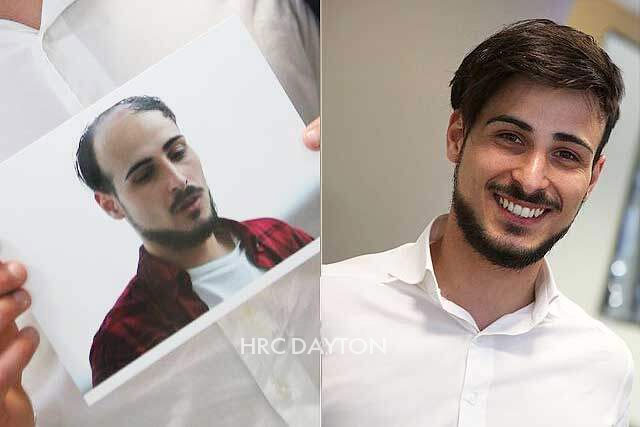
Three Critical Factors to Consider Before Deciding
1. Timeline & “Shock Loss” Reality
FUE transplants require patience. Following surgery, transplanted grafts undergo “shock loss” (telogen effluvium), shedding within 2 to 6 weeks. New hair shafts do not begin sprouting until month 3 or 4, with final density taking up to a full year to materialize.
Non-surgical hair systems eliminate this waiting period entirely. You walk into your private fitting session with thinning hair and leave with a fully restored hairline and custom cut-and-style in a single afternoon.
2. Lifestyle, Active Sports, and Maintenance
Modern hair replacement systems easily accommodate active lifestyles. Advanced, breathable medical adhesives allow clients to swim, workout, shower, and sleep with complete confidence.
However, non-surgical systems require regular maintenance. Routine salon visits every 3 to 5 weeks for cleaning, re-bonding, and styling keep the hairline invisible and skin healthy. Surgical clients must also maintain non-transplanted native hair using ongoing medical therapies to stop future loss behind the grafts.
3. Hairline Aesthetics and Artistry
Whether surgical or non-surgical, success comes down to artistry. An unnatural, straight hairline or incorrect growth angle instantly gives away a procedure. Every custom system must be tailored to match precise scalp contours, age-appropriate hairline placement, native hair direction, and natural gray percentage.
How to Determine Your Ideal Path
During a confidential consultation, we evaluate your scalp health, hair loss pattern, and lifestyle goals:
- Surgery may be an option if: You have mild hair loss (Norwood 2–3), stable loss patterns, and abundant donor hair density on the back of your head.
- Non-surgical replacement is ideal if: You have advanced thinning, diffuse thinning across the crown, limited donor hair, medical conditions preventing surgery, or a desire for immediate, guaranteed density without surgical risks.
Schedule Your Private Scalp Evaluation in Dayton
Taking control of your hair loss starts with an honest, expert assessment. Contact Hair Replacement Center of Dayton today to book a private, one-on-one consultation with our hair restoration specialists.
