
The Truth About Fixing Damaged Hair
Are you wondering if your damaged hair can truly be fixed? When conventional products fail, the answer lies in understanding the microscopic structure of your hair. This trichologist-backed guide reveals why some damaged hair doesn’t respond to typical treatments and explores professional solutions, from advanced clinical protocols to non-surgical replacement options, that can restore your hair when nothing else works.
The Microscopic Reality of Damaged Hair
What Healthy Hair Actually Looks Like
Under a trichologist’s microscope, healthy hair reveals a fascinating structure. Each strand consists of three layers:
- Cuticle: The protective outer layer with overlapping cells resembling roof shingles
- Cortex: The middle layer containing keratin proteins and melanin (color)
- Medulla: The central core (not present in all hair types)
Healthy cuticles lie flat and intact, creating a smooth, reflective surface that gives hair its shine and prevents moisture loss. The cortex remains unbroken, maintaining the hair’s strength and elasticity.
Visualizing Damage: What We See Under the Microscope
When we examine damaged hair microscopically, we observe several distinct patterns:
- Cuticle Damage: Lifted, broken, or missing cuticle cells, creating a rough surface that causes tangling and dullness
- Cortex Exposure: When cuticle damage is severe, the cortex becomes exposed to external elements
- Cortical Fractures: Cracks and splits within the protein structure of the cortex
- Protein Loss: Visible gaps in the hair’s structure where protein has been depleted
- Medullary Damage: In severe cases, damage reaches the core of the hair

Understanding these structural changes explains why some damaged hair doesn’t respond to conventional treatments—the damage exists at a level most products simply can’t reach or repair.
Types of Hair Damage: The Science of What’s Really Happening
Chemical Damage
Chemical processes like coloring, perming, relaxing, and bleaching break down the disulfide bonds that give hair its strength and structure. Our microscopic analysis of chemically damaged hair typically reveals:
- Severely disrupted cuticle patterns
- Irregular porosity (some areas absorb too much moisture while others repel it)
- Weakened internal protein structure
The Scientific Limitation: Once these bonds are broken, conventional products can temporarily mask the damage but cannot fully restore the original bond structure.
Heat Damage
Regular use of hot tools without proper protection causes:
- Dehydration of the hair’s natural moisture
- Bubble-like formations within the cortex (visible under microscope)
- Protein denaturing (similar to what happens when cooking egg whites)
The Scientific Limitation: Denatured proteins cannot return to their original state through topical treatments alone.
Environmental Damage
UV radiation, pollution, and harsh weather conditions cause:
- Oxidative stress to the hair fiber
- Degradation of the hair’s lipid layer
- Color fading and structural weakening
The Scientific Limitation: While some damage can be prevented, existing environmental damage often requires more than surface treatments.
Mechanical Damage
Brushing wet hair, tight hairstyles, and rough handling lead to:
- Cuticle lifting and stripping
- Mid-shaft splits (not just at the ends)
- Stress fractures throughout the hair shaft
The Scientific Limitation: Once the hair shaft integrity is compromised beyond a certain point, the damage is irreversible with conventional methods.>The Product Paradox: Why Your Hair Isn’t Responding to Treatments
When Conditioning Isn’t Enough
Standard conditioners and even deep conditioning treatments work primarily by:
- Coating the hair surface
- Temporarily filling in damaged areas
- Reducing friction between hair strands
While these effects can improve appearance and manageability, they don’t address fundamental structural damage. Under the microscope, we can see that even after intensive conditioning, severe internal damage remains unchanged.
The Protein Treatment Puzzle
Protein treatments can temporarily strengthen hair by providing supplemental protein to the hair shaft. However, there are significant limitations:
- These proteins cannot rebuild broken disulfide bonds
- They adhere primarily to the cuticle rather than penetrating to repair the cortex
- Overuse can cause brittleness and paradoxically lead to breakage
Why Bond Builders Have Limits
Modern bond-building treatments claim to repair broken bonds within the hair. While these can be effective for mild to moderate damage, our clinical observations show they have limitations:
- They work best on fresh damage, not long-term cumulative damage
- They cannot replace missing sections of the cuticle or cortex
- Their effectiveness decreases significantly with severely compromised hair
The Assessment: How to Tell If Your Hair is Beyond Product Repair
Self-Assessment Indicators
Look for these signs that conventional products may not be sufficient:
- The Wet Test: Damaged beyond repair hair stretches but doesn’t return to its original shape when wet, or breaks immediately
- The Porosity Check: Hair absorbs water instantly and dries very quickly
- The Elasticity Test: Hair breaks rather than stretches when gently pulled
- Persistent Problems: Issues continue despite consistent use of quality products
Professional Assessment Methods
At HRC Dayton, we use several advanced diagnostic techniques:
- Digital Microscopy: 200x magnification reveals damage invisible to the naked eye
- Hair Tensile Testing: Measures the hair’s strength and elasticity quantitatively
- Scalp Analysis: Evaluates whether damage extends to the follicle level
- Trichogram Analysis: Examines the hair roots to assess growth phase disruption
These assessments provide definitive answers about whether your hair can benefit from conventional treatments or requires more advanced solutions.
Professional Solutions When Products Fail
Advanced Clinical Treatments
For damage that’s significant but hasn’t yet reached the point of no return:
- Prescription-Strength Rebuilding Protocols: Medical-grade treatments available only through professionals
- Trichologist-Formulated Regimens: Customized treatment plans addressing your specific damage profile
- Low-Level Laser Therapy: Stimulates cellular metabolism and improves protein synthesis in the follicle
- PRP (Platelet-Rich Plasma) Therapy: Uses your body’s own growth factors to improve scalp health and hair quality
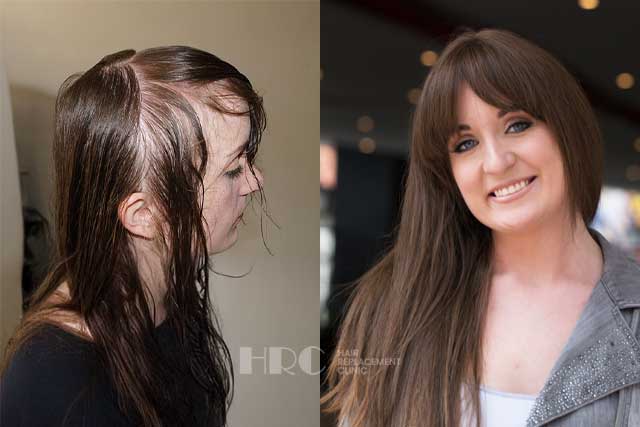
Non-Surgical Hair Replacement: The Solution for Irreparable Damage
When damage has progressed beyond what treatments can address, non-surgical hair replacement provides immediate and remarkable results:
- CNC (Capelli Naturali a Contatto) Systems: Custom-designed, breathable prosthetic hair systems matched to your exact hair color, density, and style
- Strand-by-Strand Integration: Blends replacement hair with your existing hair for a completely natural look
- Volumizing Systems: Address specific areas of thinning without replacing all hair
Unlike conventional wigs or extensions, these medical-grade solutions are:
- Secure enough for an active lifestyle
- Maintained professionally for consistent results
- Virtually indistinguishable from natural hair
The Timeline: Setting Realistic Expectations for Fixing Damaged Hair
| Damage Level | Conventional Products | Professional Treatments | Non-Surgical Replacement |
|---|---|---|---|
| Mild | 4-8 weeks | 2-4 weeks | Not typically needed |
| Moderate | Limited results even after months | 6-12 weeks | Optional for immediate results |
| Severe | Minimal improvement regardless of time | Partial improvement in 3-6 months | Immediate transformation |
| Extreme | No significant improvement | Limited improvement possible | Only viable solution for immediate and complete transformation |
Taking the Next Step: Your Personalized Hair Recovery Plan
Understanding that your hair is unique—with its own damage history and recovery potential—is the first step toward finding real solutions. When conventional products fail to fix damaged hair, professional intervention offers paths forward that aren’t available in retail products.
At Hair Replacement Clinic in Dayton, we begin every client relationship with a comprehensive assessment to determine:
- The exact nature and extent of your hair damage
- Whether conventional or professional treatments might be effective
- If non-surgical replacement would provide better immediate and long-term results
- A personalized timeline for your hair recovery journey
This evidence-based approach eliminates the guesswork and product experimentation that has likely frustrated you thus far.
Beyond the Product Promise
The science of hair damage reveals why the promise of “fixing” severely damaged hair with conventional products often falls short. While the beauty industry promotes quick fixes and miracle products, the microscopic reality tells a different story.
For those struggling with hair that seems beyond repair, understanding the structural limitations of damaged hair provides clarity and direction. Professional solutions, whether advanced treatments or non-surgical replacement, offer pathways to healthy, beautiful hair that simply aren’t available through conventional means.
The journey to truly fixing damaged hair begins with accurate assessment and realistic expectations. When you’re ready to move beyond product promises to proven solutions, our team of trichology experts is here to guide your transformation.
Fixing Damaged Hair: The Next Step
If you are ready to discover whether your damaged hair can be treated or requires replacement? Schedule a complimentary trichological assessment at HRC Dayton. Our detailed analysis will show you exactly what’s happening with your hair and provide clear direction on your best path forward. Book your complimentary hair and scalp analysis today.
This article was reviewed by the HRC Dayton Trichology Team, specialists in hair science and restoration with over 40 years of clinical experience.
